What to Expect At Your In Office Teeth Whitening Appointment

In spite of the popularity of over-the-counter teeth whitening products, professional whitening in a dentist's office still remains the gold standard for results. The products and techniques used by a dentist are carefully balanced to produce a natural level of whiteness without damaging tooth enamel. Patients seeking whiter teeth should consult with a dentist to see if professional whitening would be a safe and effective option.
What happens during an office teeth whitening appointment?
Unlike products purchased online or over-the-counter, the professional teeth whitening procedure performed by a dentist is customized to fit the patient's exact needs. The results will vary depending on the current state of the patient's teeth and any dental work that has previously been completed.
Pre-whitening assessment
Before the whitening begins, the dentist takes photographs and assesses the patient's current shade. During this time, the dentist discusses final goals with the patient and notes any previous dental work, such as tooth bonding or crowns.
Tooth polishing
The teeth are cleaned and polished to remove plaque and build-up before whitening. Polishing the teeth with a grainy, slightly abrasive material keeps the surface of the teeth consistent and can improve the final whitening outcome.
Mouth protection
Areas of the mouth surrounding the teeth need to be protected during the teeth whitening process. The gums, lips and interior mouth tissues may be pulled back with retractors during the process or protected with gauze. Gauze also serves the additional purpose of keeping the teeth dry while the whitening takes place.
Tooth whitening
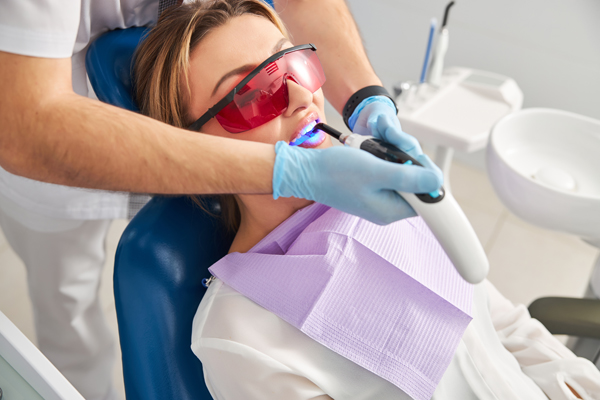
The actual teeth whitening process involves several steps. First, the dentist applies the bleaching solution to each individual tooth. This solution is applied only to the surfaces on the front of the teeth. The next step depends on the type of whitening the specific dentist provides. Some products need to be activated using a special light, while others just need to be applied and left alone for a specific amount of time. The dentist leaves the solution on the teeth until either the goal color has been reached or the maximum allowed time has expired.
Rinsing and completion
After the whitening goal has been met, the bleaching solution is rinsed off and the gauze or other protective devices are removed. Since teeth whitening can cause sensitivity with some patients, the dentist will sometimes add a fluoride solution rinse to protect the teeth. A comparison between the original color and the new color can be made at this time to determine the effectiveness of the treatment and decide if any follow-up appointments need to be made.
Aftercare
Other than avoiding food and beverages that can easily stain the teeth for at least twenty-four hours, no aftercare is needed as long as the patient does not experience excessive tooth discomfort. Tobacco use is highly discouraged during the first day after teeth whitening.
Conclusion
The process of office teeth whitening by a dentist is fast and effective. Although many patients have success with over-the-counter products, in-office whitening still remains one of the easiest ways to gain whiter teeth in a short period of time.
Are you considering teeth whitening in the Columbus area? Get more information at https://www.ohiocosmeticdentists.com.
Check out what others are saying about our services on Yelp: Read our Yelp reviews.
Recent Posts
Healthy teeth are a vital part of being able to eat and enjoy food, but certain foods can be more harmful to dental health than others. Learning about foods that help and hurt the teeth is an important part of oral hygiene basics that can be helpful in guiding the choices people make when caring…
Dental bonding is a versatile and minimally invasive cosmetic procedure that can address various dental imperfections. This procedure, involving the application of a tooth-colored resin to restore or enhance teeth, offers patients a simple and cost-effective solution for achieving a brighter, more uniform smile. Dental bonding is ideal for repairing minor dental flaws without extensive…
What are the best ways to care for your teeth? Here are some oral hygiene basics.Your teeth are essential to both comfort and health. For example, they are center stage when you smile and break up food when you eat. If you want to keep them sparkly and effective, you need to take good care…
Brushing and flossing teeth are critical oral hygiene basics that everyone should include in their care routines. Many people already know the proper procedures and benefits of brushing their teeth regularly, but flossing sometimes gets left out. In fact, according to U.S. News, only about 30% of the population in the United States flosses daily.…