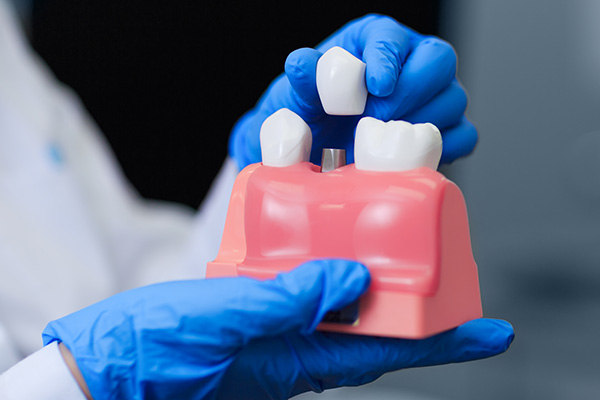
 There are several dental implant options for replacing missing teeth. A dental implant permanently replaces a missing tooth, saving smiles and helping people eat their favorite foods for years to come. Unlike other options for replacing missing teeth, dental implants do not require regular check-ups from a dentist.
The three most common types of dental implants include:
- Endosteal implants
- Subperiosteal implants
- All-on-4 implants®
While all of these implants replace missing teeth, each implant is slightly different. A professional dentist should be consulted to help choose the implant that best fits each person’s needs.
Endosteal implants
An endosteal implant consists of two parts: a small titanium screw and an artificial tooth. The titanium screw is implanted into the jawbone to act as a replacement root. The artificial tooth is attached to the top of the screw. Compared to other dental implants, endosteal implants are the most stable. Endosteal implants also require the longest treatment time because the titanium screw must fuse to the jawbone before the artificial tooth is attached.
Endosteal implants are the most common type of dental implant. However, since the implant is screwed into the jawbone, adequate jawbone density is required to receive an endosteal implant.
Subperiosteal implants
For people that do not have sufficient jawbone density or don’t want an implant in their bone, subperiosteal implants are another option for replacing missing teeth. Unlike endosteal implants, subperiosteal implants are inserted into the gum tissue and placed on top of the jawbone. Subperiosteal implants consist of a metal frame that is implanted in the gum tissue. This frame has posts where artificial teeth are attached. Because the metal frame is not implanted into the jawbone, subperiosteal implants are less stable than endosteal implants but are a suitable dental implant option for people with low jawbone density.
All-on-4 implants
Both endosteal implants and subperiosteal implants are suitable options for people who have lost only a few teeth. If a person has lost an entire row of teeth due to gum disease, All-on-4 implants may be a more fitting option for replacing missing teeth. To attach an All-on-4 implant, a professional dentist will implant four titanium screws into a person’s jawbone. Unlike an endosteal implant, in which only one artificial tooth is attached to each screw, in All-on-4 implants, a full set of artificial teeth is attached on top of the screws. Thus, All-on-4 implants replace more teeth at a time compared to endosteal implants and subperiosteal implants.
Choosing the right dental implant
Having missing teeth may negatively affect a person’s dental health and self-esteem. Luckily, there are several dental implant options for replacing missing teeth. People with sufficient jawbone density will benefit from an endosteal implant. Those with less jawbone density can receive a subperiosteal implant. Those that need to replace an entire set of teeth should consider an All-on-4 implant. Nevertheless, a professional dentist should be consulted to help choose the right dental implant for each person.
Recent Posts
A missing tooth can be more than an aesthetic concern; it can significantly affect overall oral health. Beyond the visible gap, a missing tooth can cause a variety of dental issues that, if left untreated, can impact jawbone health and smile alignment. Addressing a missing tooth by consulting a general dentist helps restore appearance, function,…
Though a seemingly small problem to some, just a single missing tooth disrupts the alignment of your smile and can lead to bone loss and difficulties with chewing. Fortunately, modern dentistry offers several effective single-tooth replacement options. Knowing these options and the type of tooth replacement that suits you can help you make an informed…
There are many options for replacing missing teeth, but how can replacing missing teeth help your oral health? Replacing missing teeth is the best way to prevent tooth decay, gum disease, and jawbone deterioration. Options for replacing missing teeth are dental implants, dentures, or dental bridges. Choosing which option will work best for you depends…